
Three-Place Membrane Filtration Devices: A Practical Option for Microbiology Labs
What Is a Three-Place Membrane Filtration Device?
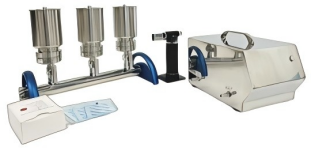
At its core, the device consists of a stainless steel or autoclavable plastic base, three funnel supports, a vacuum manifold, and individual valves to control each filtration port. Each port accepts a funnel that holds a membrane filter. When vacuum is applied, liquid is drawn through the membrane, capturing microorganisms on the filter surface. The membrane can then be transferred to culture media for incubation and colony counting.
These devices are widely used in pharmaceutical microbiology, clinical labs, food safety, and environmental testing where sample volumes are moderate and aseptic technique is non-negotiable. According to Standard Methods for the Examination of Water and Wastewater (APHA, AWWA, WEF), membrane filtration is a cornerstone method for enumerating bacteria, coliforms, and other indicators in water quality testing, and multi-place manifolds enhance workflow without sacrificing reproducibility.
How the Three-Place Workflow Improves Lab Efficiency
Instead of processing one sample at a time, a three-place device lets technicians run up to three filtrations in parallel. This cuts total processing time significantly when multiple samples are involved. Key workflow advantages include:
- Reduced hands-on time: Set up three funnels, apply vacuum, and monitor simultaneously.
- Consistent vacuum: One pump feeds all three ports, ensuring uniform filtration rates.
- Smaller footprint: One device replaces three single-place setups, saving bench space.
- Simplified cleaning: A single manifold with removable components is easier to sterilize than multiple individual units.
For labs running daily water quality checks or routine bioburden testing, the three-place configuration often matches the average batch size without unused ports gathering dust.
Sample Volume Handling and Practical Limits
Typical three-place devices accept standard 47 mm or 50 mm diameter membrane filters and can handle sample volumes from a few milliliters up to several hundred milliliters per funnel, depending on funnel design and vacuum strength. However, there are practical limits:
| Parameter | Typical Range for Three-Place Devices |
|---|---|
| Membrane diameter | 47 mm or 50 mm (most common) |
| Max sample per funnel | 100–250 mL (standard funnel); up to 500 mL with taller funnels |
| Total filtration capacity | Up to 750 mL across three ports (with 250 mL funnels) |
| Vacuum requirement | Typically -0.5 to -0.7 bar (requires a compatible vacuum pump) |
| Filtration time | Depends on sample turbidity; typically 1–5 minutes per batch |
For very large volumes (≥1 L per sample), a peristaltic pump setup or a vacuum flask with a larger single-port funnel may be more practical. Always match funnel size to expected sample load to avoid overflow or incomplete filtration.
Routine Microbial Testing Applications
Three-place membrane filtration devices appear in several routine microbiology workflows:
- Water quality testing: Detection of coliforms, E. coli, total plate count, and Pseudomonas in drinking water, process water, or environmental samples.
- Bioburden monitoring: In pharmaceutical and medical device manufacturing, to assess microbial levels in raw materials, in-process fluids, and final rinse samples.
- Sterility testing: Membrane filtration is a preferred method for sterility tests of liquid pharmaceuticals, as described in pharmacopeial methods (e.g., USP <71>). A three-place manifold can run multiple product containers in parallel.
- Beverage and food safety: Filtration of clear liquids (juices, wine, beer) for yeast, mold, and spoilage organisms.
- Environmental monitoring: Air sampling impinger liquids can be filtered to capture airborne microbes.
For labs that regularly test fewer than ten samples per day, a three-place system is often the most ergonomic choice, providing enough capacity without overspending on a six-place manifold.
Key Selection Criteria for a Three-Place Filtration System
Not all three-place devices are alike. Before purchasing, consider these factors:
- Material construction: Stainless steel (316L) is durable and fully autoclavable; some devices use autoclavable polymers for lighter weight.
- Valve type: Individual stopcocks allow independent control; check for smooth operation and chemical resistance.
- Funnel compatibility: Ensure the device accepts your preferred funnel design (magnetic, clamp-on, or screw-type).
- Membrane size support: Confirm that standard 47 mm or 50 mm filters fit securely.
- Sterilization method: The entire manifold and funnels should be autoclavable or easily disinfected with alcohol.
- Vacuum connection: A universal port that fits common vacuum tubing; some devices include a built-in vacuum gauge.
- Footprint: Compact size is a selling point; measure your laminar flow hood or bench before ordering.
- Warranty and spare parts availability: O-rings, gaskets, and valves degrade over time; having a reliable source for replacements is crucial.
Maintenance and Daily Care
Proper maintenance keeps a three-place membrane filtration device contamination-free and leak-free. Follow these steps:
- After each use: Rinse all funnels and the manifold base with purified water to remove residual sample.
- Disinfect: Wipe surfaces with 70% ethanol or a suitable disinfectant; avoid abrasive cleaners that may scratch stainless steel.
- Inspect seals: Check O-rings and gaskets weekly; replace if cracked or stiff.
- Autoclave regularly: Most stainless steel manifolds can be autoclaved at 121°C for 15–20 minutes. Always consult the manufacturer’s instructions.
- Lubricate valves: If valves become stiff, a small amount of silicone lubricant (autoclavable) can restore smooth operation.
- Verify vacuum integrity: Periodically test with a dry run to ensure the manifold holds vacuum without leaks.
A well-maintained three-place filtration device can serve a lab for a decade or more, making it a solid long-term investment.
When to Choose Three-Place Over a Single-Place Manifold
| Scenario | Recommendation |
|---|---|
| Low sample volume (<3 samples/day) | Single-place setup may suffice; less cleaning overhead. |
| Moderate daily throughput (3–12 samples) | Three-place device is ideal—boosts efficiency without wasted ports. |
| Multiple shifts or high workload | Consider a six-place manifold for maximum throughput. |
| Budget constraint | Single-place units are cheaper upfront, but three-place saves time and pump wear over the long run. |
| Bench space is limited | Three-place offers a compact multi-sample solution. |
For many mid-sized microbiology labs, the three-place membrane filtration device hits the sweet spot between capacity and simplicity, making it a practical workhorse for routine testing.
For system-level planning, our Laboratory Equipment Solution page can help buyers connect equipment selection with real hospital or laboratory workflows. Related equipment pages include HD-F3 Three-Place Microbial Membrane Filtration Device and HD-F6 Six-Place Microbial Membrane Filtration Device.