
Six-Place Microbial Membrane Filtration Devices for High-Volume Laboratory Testing
What Is a Six-Place Microbial Membrane Filtration Device?
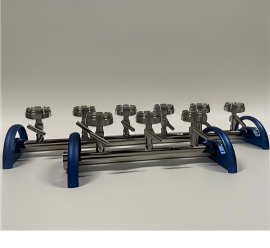
A six-place microbial membrane filtration device is a benchtop or cart-mounted vacuum filtration manifold that holds up to six filter funnels at once. Each funnel position accepts a standard filter membrane, typically 47 mm in diameter, and each can be operated independently or as part of a shared vacuum system. The device is used to concentrate microorganisms from liquid samples onto membrane filters, which are then transferred to culture media for incubation and colony counting. This design is widely used in microbiological water testing according to methods like Standard Methods for the Examination of Water and Wastewater, pharmaceutical water system monitoring under USP <1231>, and industrial food safety screening.
How the Six-Place System Improves High-Throughput Testing
The main advantage of a six-place design is throughput. Instead of processing one sample at a time, a technician can load six funnels, adjust the vacuum, and filter them in parallel. This significantly reduces the total hands-on time per sample batch. For labs running dozens of samples daily, a six-place device can shorten sample turnaround times and free up staff for other tasks. In addition, parallel filtration reduces the total pumping time because all six positions share the vacuum, making the process more energy-efficient than running multiple single-place devices.
Vacuum Stability and Why It Matters
Uneven vacuum across the six positions can cause inconsistent flow rates, which may affect organism recovery. A well-designed six-place manifold maintains equal vacuum at each port, even when fewer than six funnels are in use. Some devices feature individual stopcocks for each position, allowing the operator to close unused ports without disrupting the vacuum to active funnels. This is especially important when running different sample types or volumes in the same batch. Consistent vacuum pressure helps ensure that each membrane experiences the same filtration conditions, which is critical for reproducible results.
Parallel Testing and Workflow Efficiency
Parallel testing does more than save time; it reduces the risk of sample-to-sample variability caused by differing laboratory conditions. When all six samples are filtered within the same timeframe, they are exposed to the same temperature, pump vacuum, and operator handling. This consistency supports better comparability between replicates. For laboratories following ISO 8199:2018 guidance on quality control for microbiological examinations, parallel processing helps meet reproducibility expectations. The six-place layout also fits well within standard biosafety cabinets, allowing aseptic operation without crowding the workspace.
Cleaning and Maintenance for Consistent Results
Cross-contamination is a major concern in any filtration system. A thorough cleaning protocol is necessary after each use to prevent carryover of organisms or chemical residues. Most six-place devices are designed for easy disassembly: the filter heads, support bases, and manifold can be removed and autoclaved or chemical sterilized. Stainless steel manifolds are common because they withstand repeated sterilization cycles. Silicone or PTFE seals should be inspected regularly for wear, as failing seals can cause vacuum leaks or sample bypass. A typical cleaning checklist includes:
- Rinse all parts with warm water immediately after use to remove residue.
- Disassemble the filter heads and manifold connections.
- Autoclave metal components at 121°C for 15–20 minutes or use a validated chemical sterilant.
- Inspect and replace O-rings or gaskets if cracked or discolored.
- Reassemble and perform a leak test with sterile water before the next run.
When to Use a Six-Place vs. a Single-Place or Three-Place Filtration System
Choosing the right device depends on daily workload, sample types, and available bench space. The table below compares the three most common configurations:
| Feature | Single-Place | Three-Place | Six-Place |
|---|---|---|---|
| Throughput (samples/hour) | Low | Moderate | High |
| Footprint | Compact | Medium | Larger |
| Vacuum management | Simple, no balancing needed | May require careful valve control | Requires stable vacuum manifold with individual valves |
| Best for | Occasional testing, verification runs | Moderate routine workloads | High-volume daily testing, parallel replicates |
| Cost comparison | Lowest initial investment | Mid-range | Higher initial investment, but lower cost per sample |
For labs that consistently process more than 20 samples per day, the six-place device offers the best balance of efficiency and cost per test. However, if bench space is limited or the workload is unpredictable, a three-place system may be more practical.
Practical Considerations for Busy Laboratories
Before adopting a six-place filtration device, lab managers should evaluate a few operational factors:
- Vacuum pump sizing: The pump must deliver stable vacuum across all ports. An undersized pump can cause inconsistent flow and extended filtration times.
- Funnel and membrane compatibility: Most devices accept standard 47 mm membranes, but some require specific funnel types or adapters.
- Sterilization access: If the device cannot be autoclaved as one piece, plan for disassembly space and sterile storage.
- User training: Even though the concept is simple, improper valve handling or uneven loading can compromise results.
- Serviceability: Check whether replacement parts (valves, seals, filter supports) are readily available.
In pharmaceutical QC laboratories, for example, the device is often placed inside a laminar flow hood. The footprint and height of a six-place manifold can affect hood ergonomics, so measuring the workspace is an essential step.
References
- Standard Methods for the Examination of Water and Wastewater, 23rd Edition, American Public Health Association.
- United States Pharmacopeia, Chapter <1231> Water for Pharmaceutical Purposes.
- ISO 8199:2018, Water quality – General requirements and guidance for microbiological examinations by culture.
For system-level planning, our Laboratory Equipment Solution page can help buyers connect equipment selection with real hospital or laboratory workflows. Related equipment pages include HD-F6 Six-Place Microbial Membrane Filtration Device and HD-F3 Three-Place Microbial Membrane Filtration Device.